
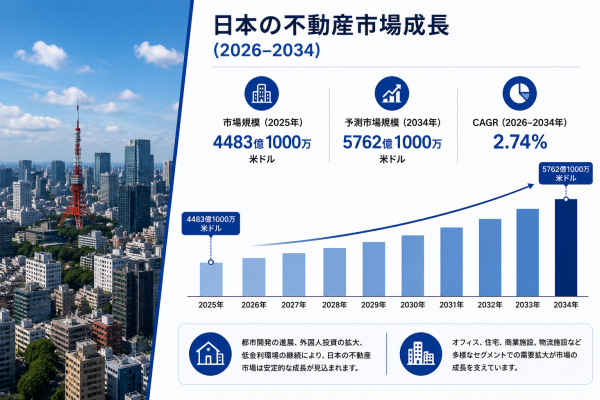
Market Size in 2025: US$448.31 billion
Market Forecast for 2034: US$576.21 billion
Market Growth Rate: 2.74% (2026-2034)
According to the latest report "Japan Real Estate Market: Industry Trends, Share, Size, Growth, Opportunities, Forecast 2026-2034" published by the IMARC Group, the size of the Japanese real estate market reached US$448.31 billion in 2025. Looking ahead, the market size is projected to reach US$576.21 billion by 2034, with a compound annual growth rate (CAGR) of 2.74% from 2026 to 2034.
Download a sample PDF of this report: https://www.imarcgroup.com/report/ja/japan-real-estate-market/requestsample
Trends and Demand in the Japanese Real Estate Industry in 2026:
The Japanese real estate market is growing, steadily driven by urban redevelopment projects, the need for modernization of housing, and increased investment in commercial and industrial real estate. The market includes diverse target properties for various market sectors, including residential, commercial, industrial, and land. The operation of target industries consists of buy-and-sell transactions and agreements lease that provide various revenue streams. Distribution channels are both online and offline transactions, allowing customers to choose flexible purchase options. Residential real estate is the largest segment by value. Commercial real estate promotes urban regeneration. Investment in industrial facilities supports manufacturing. Land development creates forward-looking opportunities. Patterns of housing demand due to teleworking. Revitalized urban regeneration is the regeneration of aging urban areas. Concerns about sustainability are influencing real estate selection factors. Japanese real estate companies and global investors are expanding their portfolios, pursuing mixed-use development projects, and acquiring sustainable assets. Property location, development quality, and return on investment are key competitive advantages.
The market is a mirror reflecting the evolving maturity of the real estate market and the sophistication of investments. High-location properties in the residential sector maintain high prices. The office market is adapting to hybrid work models. Retail real estate is adapting to online retail competition. Industrial real estate is being strengthened by expanding logistics demand. Land development offers long-term value creation opportunities. Selection criteria include environmental sustainability. Digital platforms allow users to find properties at their convenience. Japanese real estate developers and global funds are expanding their portfolios, developing smart building solutions, and investing in technologies that support market evolution and adaptation.
How AI will transform the future of the Japanese real estate market:
Real estate valuation and price forecasting: AI will analyze comprehensive market data and support investment decisions by predicting real estate prices with high accuracy. Machine learning will identify market trends and investment opportunities, enabling informed trading. These capabilities will benefit all market participants by improving pricing accuracy and supporting optimal investment timing. Demand Forecasting and Market Analysis: AI predicts real estate demand patterns regardless of region or property type, supporting development decisions. Machine
learning identifies emerging trends and investment opportunities.
and Customer Experience: AI matches buyers and tenants with the best properties based on individual preferences. Machine learning algorithms personalize property recommendations, improving conversion rates. These technologies enhance the customer experience and increase sales efficiency.
Segmentation of the Japanese Real Estate Market:
The market report provides a comprehensive analysis of each segment, highlighting the largest segments. Japanese Real Estate Market Share. This includes forecasts from 2026 to 2034 and historical data from 2020 to 2025 for the following segments.
Target Property Type:
Residential
Commercial
Industrial
Land
Target Industry:
Buying and Selling
Rental
Target Form:
Online
Offline
Regional Analysis:
Okinawa
Region Kinki
Region
Chubu Region Kyushu-Okinawa
Region Tohoku
Region Chugoku Region
Hokkaido Region
Shikoku Region
Competitive Landscape:
This report provides a detailed analysis of the competitive landscape. It includes a thorough competitive analysis including market structure, positioning of key players, key strategies for success, a competitive dashboard, and company valuation quadrants. Furthermore, this report also features detailed profiles of all major companies in the Japanese real estate industry.
Mitsui Fudosan Co., Ltd.
Sumitomo
Realty & Development Co., Ltd.
Daiwa House Industry Co., Ltd.
Tokyu Fudosan Holdings Nomura
Real Estate Holdings Co.,
Ltd. Sekisui House, Ltd.
Latest News and Trends in the Japanese Real Estate Market
March 2026: Real estate developers announced new urban regeneration projects and sustainable real estate developments that support modernization and environmental initiatives.
February 2026: Companies expanded their digital platforms and introduced smart real estate technologies to improve customer experience and operational efficiency.
In Progress: Increased investment in urban redevelopment, sustainable real estate, digital platforms, and smart real estate technologies is continuously transforming the Japanese real estate market.
Frequently Asked Questions (FAQ)
What is the size of the Japanese real estate market?
The Japanese real estate market is projected to reach US$448.31 billion in 2025 and US$576.21 billion in 2034, growing at a compound annual growth rate (CAGR) of 2.74% from 2026 to 2034.
What are the factors driving the growth of the Japanese real estate market?
Key growth drivers include urban redevelopment plans, demand for housing modernization, commercial real estate development, industrial facility investment, development of remote work environments, focus on sustainability, and adoption of digital platforms.
Which industries are adopting the solution in the Japanese real estate market?
The solution is widely adopted across a wide range of industries, including residential real estate developers, commercial real estate companies, industrial real estate investors, property management companies, real estate brokers, and institutional investors.
Which regions dominate the Japanese real estate market?
Major regional markets include Kanto, Kinki, Chubu, Kyushu-Okinawa, Tohoku, Chugoku, Hokkaido, and Shikoku.
Note: If you require specific information outside the scope of this report, we can provide it as part of a customization.
About Us:
IMARC Group is a global management consulting firm that helps the world's most ambitious changemakers create lasting impact. provides comprehensive services for market entry and business expansion. IMARC's services include thorough market assessment, feasibility studies, company formation support, factory setup support, regulatory approval and licensing support, branding, marketing and sales strategies, competitive landscape analysis and benchmark analysis, pricing and cost analysis, and procurement research.
配信元企業:IMARC Group Pvt.Ltd.
プレスリリース詳細へ
ドリームニューストップへ
